Présentation
L’Institut français NL et le Nieuwe Instituut s’associent pour inviter Estelle Zhong Mengual à prendre part au projet Zoöp Connections porté par EUNIC Netherlands. L’historienne de l’art française participera du 7 au 10 avril 2025 à un programme de réflexion, d’expérimentation et d’échanges sur les liens entre le monde vivant et les institutions culturelles. L’objectif de cette invitation sera d’interroger la manière dont les principes de régénération écologique et la co-gouvernance avec les entités non-humaines peuvent redéfinir le rôle des institutions culturelles face aux enjeux climatiques.
Apprendre. Dans un premier temps, le programme s’attachera à encourager le partage de connaissances, la réflexion et l’apprentissage. Estelle Zhong Mengual sera ainsi amenée à rencontrer des Représentants du vivant en visitant différentes organisations Zoöp : De Ceuvel à Amsterdam, Buitenplaats Brienenoord et le Nieuwe Instituut à Rotterdam. C’est par ailleurs au Nieuwe Instituut que le modèle Zoöp a été développé et adopté pleinement pour la première fois. De plus, des rendez-vous individualisés et collectifs permettront à Estelle Zhong Mengual d’échanger avec des acteurs des champs de la recherche, de l’éducation et de la création artistique qui contribuent au modèle Zoöp au Nieuwe Instituut.
Organiser. En parallèle, le programme visera à favoriser l’émergence de nouvelles relations et à imaginer de nouvelles structures, fondées sur des principes transformateurs de collaboration et d’organisation. Un déjeuner de réseautage avec une dizaine de professionnels de musée, de curateurs, de chercheurs et les partenaires du projet facilitera le dialogue entre Estelle Zhong Mengual avec des acteurs de premier plan de la scène culturelle néerlandaise qui travaillent sur les principes de régénération.
Co-créer. Enfin, le programme s’appuiera sur l’implication active des participants néerlandais dans une démarche de co-création afin de provoquer un changement profond. Un groupe de travail avec cinq participants néerlandais sera constitué pour nourrir une réflexion collective et développer le partage de connaissances avec Estelle Zhong Mengual. Enfin, l’historienne de l’art française sera invitée à contribuer en tant que conférencière d’honneur au symposium « Compos(t)ing: Regenerative Creative Practices » organisé le 10 avril par le Nieuwe Instituut en partenariat avec plusieurs écoles d’art et de design néerlandaises ; elle y présentera les grandes perspectives de son travail et s’en servira pour nourrir une réflexion sur les échanges auxquels elle aura pris part au tout long de la journée.
Biographie
Estelle Zhong Mengual est historienne de l’art. Normalienne et titulaire d’un doctorat de Sciences Po Paris, elle a enseigné pendant six ans dans le Master d’Expérimentation en Art et Politique (SPEAP), créé par Bruno Latour à Sciences Po Paris. Elle est aujourd’hui responsable de la chaire « Habiter le paysage. Pratiques artistiques de l’hospitalité pour le vivant » à l’École nationale supérieure des Beaux-Arts de Paris (ENSBA).
Elle est l’auteur de plusieurs ouvrages, dont Apprendre à voir (publié en néerlandais Leren Kijken en 2024), dans lequel elle propose de nouvelles façons d’aborder la représentation du monde vivant en art, en s’appuyant sur les outils des humanités environnementales et des sciences naturelles les plus contemporaines. Avec le chorégraphe Jérôme Bel, elle a co-créé deux spectacles explorant nos relations avec le vivant : Non-human dances, présenté en avant-première au Louvre en 2023, et Starting this world anew (2024), mettant en scène l’actrice flamande Jolente de Keersmaeker.

Texte de restitution – Estelle Zhong Mengual
The word “meaningful” is one of my favorite words and there is no equivalent for it in French, my mother tongue. “Meaningful” binds together the quality of being important and the quality of having meaning until they become inseparable: something is imbued with significance when it exists very strongly in the life of someone.
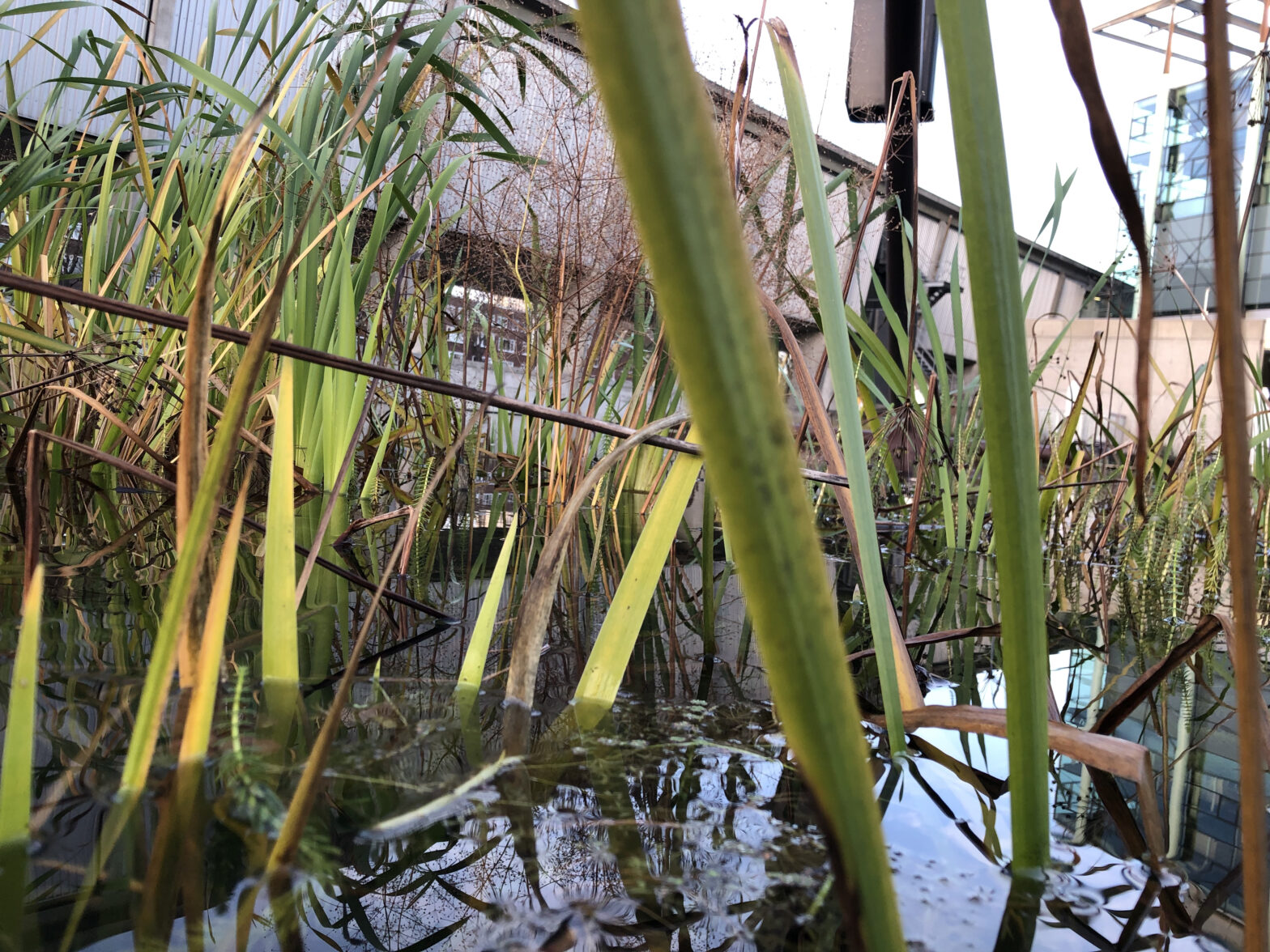
“Meaningful” is the word that came to me last April when listening to Thijs de Zeeuw to describe his experience as a Speaker for the Living at the Zoöp de Ceuvel in Amsterdam. He was explaining to me how his mission consists in trying to see De Ceuvel from other perspectives than his own. Take this riverbank just a few feet away from the bar tables: a welcoming sight where you want to drink a beer. But this bank doesn’t only exist in our human-framed world. It’s also flashing as a site of interest in the bees’ field of attention. Here water is shallower: it could be a treasured place to rest and drink. Only there was nothing for them to land on: that’s why Thijs added a pile of branches alongside the bank so that it could become welcoming to more life forms than us. The gesture seems ridiculous: it doesn’t look like anything grand and it sure doesn’t look pretty (which is a recurrent problem: how humans tend to find messy the habitats of other beings than themselves and destroy them – sometimes aesthetics taste is not only a bourgeois problem but a matter of life and death for non-humans). But it’s better than grand and pretty: it’s world-expanding.
Suddenly, you enter a world where things are not what they seem to be. This sand pile is not just a sand pile: it means “life” for burrowing bees. This ladder by the canal is not just a ladder; it means “home” for tubeworms. This wild reseda in the Nieuwe Instituut’s garden is not just a flower: it means “center of the world” in the life of the the yellow-faced mask bee, a species rarely found in Dutch cities. Suddenly, nothing is “just”. Suddenly, everything is “more”. Visiting De Ceuvel or the New Garden in Nieuwe Instituut makes you feel dizzy. Everywhere you look, every little corner, every inch could be a place that means something to someone you don’t see.
Meaningfulness is everywhere: this rock, this trunk, this water temperature, this plant, this roof is layered with hidden significations and secret relationships woven through time by other life forms than us. That’s the kind of emotion you usually have in front of a Vermeer’s painting or Sint-Bavokerk: a sense of depth in front of the historical sedimentation of meanings. This means that culture, defined as such, is an invention of life itself, not a human invention. Giving meaning, finding meaning – value and significance – that persists over time, that is passed on generation after generation, is not an intellectual human affair. It is what life does.
This dizzying experience made me realize how easily human land management can undo what we call environments and are more accurately worlds, slowly built through millions of years of inherited and invented non-human meanings. This also made me realize how life can spring back if given the opportunity to thrive – which is what Zoöps are aiming to do. If you invite them, they come. Despite all we have done to diminish them, if we do it right, even in the middle of a seemingly inhospitable city like Rotterdam – they will come. It’s one of the strongest ecological emotions I have ever experienced.
And yet, there is a paradox: we tend to be more sensitive to the meaningfulness of the living world when there are human intentions behind it. “A well-maintained garden path says: all this wilderness on the left and right is meant to be that way” writes Peter Zwaal, assistant gardener at Nieuwe Instituut. Otherwise, we tend to find this garden path just ugly and not infused with non-human meaning. Human intentions, under the guise of human design and engineering, make nonhuman habitats more acceptable, approachable, decipherable, and valuable for us. It’s as if we had never been emancipated from the toxic fable of the Garden of Eden, where everything feels full of purpose and wonder only because a human-like figure created it. And sometimes marveling at human inventiveness can obliterate, once again, the inventiveness of others.
This is why I see a fully accomplished Zoöp as not only a place where space is deliberately shared with other lifeforms – but where the ability of creating and giving meaning, and thus deciding what is important, is deliberately shared with them. A place where meaningfulness is no longer a human monopoly. Where design is also oriented towards the goal of rendering human visitors not only sensitive to the mere presence of plants, non-human animals, mushrooms, bacteria, but also sensitive to how they are shaping the place with their own ways of creating meaning and value. This is perhaps my take on what a regenerative relationship can look like: a relationship where meaning flows from one form of life to another and where we let what is meaningful for other lifeforms transform what is meaningful for us.
À Propos
Zoöp Connections est une initiative de EUNIC Netherlands, coordonnée par DutchCulture et le Nieuwe Instituut, en collaboration avec le Zoönomic Institute. Les résidences sont organisées par les duos suivants, associant chacun un Zoöp à un membre de EUNIC Netherlands : Zoöp Kunstfort bij Vijfhuizen et British Council Netherlands, Zoöp Stichting Bodemzicht/’t Gagel et Vlaams Cultuurhuis de Brakke Grond, Zoöp De Ceuvel et Goethe-Institut Niederlande, Zoöp Creative Coding Utrecht et Instituto Cervantes Utrecht, Zoöp Nieuwe Instituut et Institut français NL.
Partenaires
- Dans le cadre de : Zoöp Connections
- Organisé par : EUNIC Netherlands, DutchCulture et le Nieuwe Instituut
- En partenariat avec : Institut français NL
- Crédit photo Nieuwe Instituut : Patricia de Ruijter